
How to Massage Your Own Neck and Shoulders Between Visits
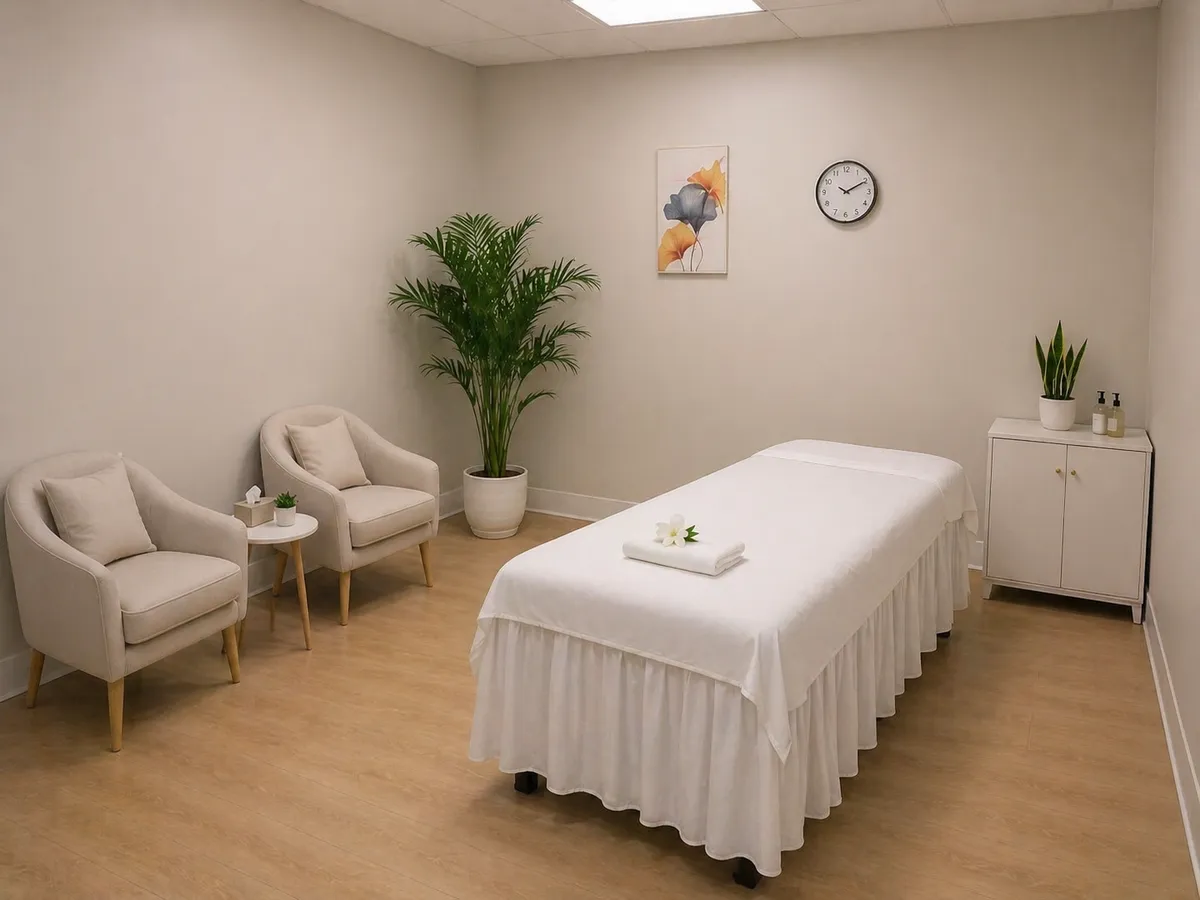
Professional massage works better when you maintain it between sessions. Here are the techniques we recommend.
Why Self-Massage Helps
The biggest mistake in chronic neck and shoulder tension is doing nothing between professional sessions. The tension comes back faster than the body can release it permanently.
Five minutes of self-massage daily extends the benefit of every professional session — sometimes dramatically.
Tools You Can Use
Tennis ball or lacrosse ball. The single most effective self-massage tool. Place against a wall, lean into it, target tight spots in upper trapezius, between shoulder blades, glutes.
Foam roller. Excellent for upper back, lats, and lower back. Less precise than a ball but covers larger areas.
Your own thumbs. For neck, scalp, jaw, hands, feet — your thumbs are the right tool.
Theracane / massage stick. Useful for hard-to-reach spots in upper back.
Daily 5-Minute Routine for Neck and Shoulders
Step 1 (1 min): Suboccipital release. Lie on your back. Place your thumbs at the base of your skull, just above where it meets your neck. Apply gentle sustained pressure for 30 seconds at a time, moving slightly along the ridge.
Step 2 (2 min): Upper trapezius tennis ball. Place a tennis ball against a wall. Lean into it with your upper trapezius (the muscle from neck to shoulder). Find a tight spot. Hold sustained pressure for 30 seconds. Move to the next spot. Cover both sides.
Step 3 (1 min): Pec stretch. Stand in a doorway. Place forearm against the doorframe at shoulder height. Step forward gently to stretch the chest and front of shoulder. Hold 30 seconds each side.
Step 4 (1 min): Neck rotation. Slowly turn your head to one side, holding 5-10 seconds. Repeat to the other side. Then chin to chest, then chin up. Move slowly; never force.
What Self-Massage Can't Replace
Self-work has real limits. You can release some surface tension but you can't reach the deep paraspinal layers, the gluteal-hip complex, or the levator scapulae effectively on your own. Professional sessions reach what self-work can't.
Think of self-massage as maintenance between sessions, not a replacement.
When Self-Massage Helps Most
- Daily desk workers — every hour, 1-2 minutes of self-work prevents the build-up
- Travelers — keeps tension from locking in during long flights or drives
- Active recovery — speeds recovery between training sessions
- Stress days — quick reset
Common Self-Massage Mistakes
Pressing too hard. Sustained moderate pressure is more effective than aggressive pressure. The muscle releases when it feels safe.
Going too fast. Hold each spot 30+ seconds. Quick rubbing doesn't release deep tension.
Working only the painful spot. Tension often refers from elsewhere. If your neck hurts, also work the upper trapezius and the muscles between your shoulder blades.
Skipping the breath. Breathe slowly during pressure. Holding your breath tightens the muscle and prevents release.
How This Applies to Your Visit at Redwood Health Center
Everything described above informs how we approach every session at our Main Street location in Redwood City. With eight licensed therapists and 100+ years of combined experience, we have the depth to match each client's specific needs to the right person on our team.
If you're booking a session and want to apply what you've read here, the easiest approach is to call us at 650-868-5088 and describe what you're working with. We'll match you to the therapist whose specialty fits, suggest the duration that makes sense, and get you scheduled.
Common Questions Our Clients Ask
How quickly can I get an appointment? Same-day or next-day for most weekday slots. Weekends and evenings (after 6pm) often book out 2-3 days ahead. Same-day availability isn't always available with our most-requested therapists; book ahead when you can.
Do I need to mention specific issues when I book? Yes, please. Telling us up front whether you're dealing with chronic pain, looking for relaxation, or recovering from training lets us match you to the right therapist and prepare the room appropriately. Surprises don't help us help you.
What if I'm not sure which service to book? Just call us. Tell us what's bothering you or what you're hoping to get from the session. We'll suggest the right service. There's no penalty for "I don't know" — most of our first-time clients start that way.
What's your cancellation policy? 4 hours' notice for cancellation or rescheduling. We're flexible for genuine emergencies. Same-day cancellations and no-shows may incur a charge.
Can I book online? Currently we book by phone (650-868-5088) and through our chat (bottom right of any page). The reason: matching the right therapist to your needs is something we'd rather do through brief conversation than through a form.
Our Approach in One Paragraph
We're a small, focused therapeutic massage spa in downtown Redwood City — 260 Main St, Suite F. Open every day from 9am to 10pm. Eight licensed therapists with 8 to 30+ years of practice. Pricing is intentionally accessible: 60-min sessions $59, 30-min $39, Featured Combo $89. FREE 15-minute hot stone treatment with any service. We don't sell packages with expiration dates and we don't push upgrades. The goal is simple: that you leave feeling better than when you came in.
Practical Logistics for Booking Your Session
For clients ready to act on what's described above, the practical mechanics of working with us:
Phone booking: 650-868-5088. Available all open hours (9am to 10pm, every day). The receptionist will take you through service selection, therapist matching, and scheduling. Most calls take 3-5 minutes.
Chat booking: Bottom right of any page on our website. Available 24/7. Useful when you have specific questions or want to describe a complex issue before committing to a session. Response time during open hours is usually under 5 minutes.
Same-day appointment: Sometimes possible. Our therapists are typically booked, but if there's an opening we can fit you in. Call ahead to check.
Same-day vs advance booking: Same-day works for most weekday slots. Friday evenings and weekend slots fill 2-3 days ahead. The most-requested therapists (Edman, Jack) often book a week ahead during busy periods.
What to bring: Nothing required. Comfortable clothes for arrival and departure. We provide everything else — sheets, oils, robes, water.
Your First 60 Seconds With the Therapist
The brief consultation at the start of every session is more important than most clients realize. The therapist is making rapid assessments based on what you tell them and what they observe. The clearer you are in those first 60 seconds, the more targeted the work will be.
The questions worth answering specifically:
- Where exactly is the issue? "My neck" is vague. "The right side of my upper trapezius, just above the shoulder blade" is specific.
- How long has it been there? "A week" requires a different approach than "three years."
- What aggravates it? Specific positions, specific activities, specific times of day.
- What relieves it (even temporarily)? This tells the therapist what kinds of input the body responds to.
- Anything to avoid? Recent injuries, areas of skin sensitivity, areas you don't want worked on for any reason.
- What's the goal? Pain relief? Relaxation? Recovery? The session shape changes based on which.
What Tells You the Session Worked
The honest indicators that a session was effective:
In the first hour after: A quiet, slightly slow feeling. Reluctance to immediately return to busy activity. Mild thirst.
That night: Better sleep. Falling asleep faster. Waking less. Sleeping through usual disruptions.
The next morning: Better range of motion than yesterday. The chronic pain or tension you came in with is at minimum reduced — often noticeably less.
Day 2: Possibly mild soreness if you had deep work, similar to the day after a workout. Drink water; it resolves quickly.
Day 3-5: The cumulative benefit. Many clients report feeling better than they did before the session — calmer, more flexible, sleeping better.
If you notice none of these in the days after a session, the work didn't fully connect with what your body needed. That's useful feedback. Tell us at your next appointment so we can adjust technique, therapist match, or both.
Why Consistency Matters More Than Intensity
If we could give one piece of advice to every client about therapeutic massage, it would be this: consistency dramatically outperforms intensity. Two 60-minute sessions per month for a year does more for chronic conditions than a single dramatic 120-minute session per quarter.
The body learns from repeated input. A consistent rhythm of moderate sessions teaches the nervous system and the tissue that release is the new normal. A rare, dramatic session creates a temporary peak that fades back to baseline.
This is why we don't sell prepaid packages with expiration dates — we want clients booking when their bodies need it, not booking 10 sessions in 30 days because the package is expiring. The right rhythm is whatever you can sustain over time.
For most clients, that turns out to be every 2-3 weeks. For some, weekly. For others, monthly. The right answer is whatever you'll actually keep doing.
Ready to Book?
Visit our Complete Guide to Massage in Redwood City for deeper articles on choosing the right session.
Call: 650-868-5088